
When your child tells your they want to play Rugby it’s good to know that there are a number of different options available to them, based on their age, location and physical abilities.
What’s is rugby?
The term “Rugby” can be confusing, as there are different types of games that are all referred to as Rugby.
This is because Rugby is not the true name of any sport!
Rugby Union is official name of one of two “codes” of Rugby Football, the other being Rugby League.
These two sports share a lot of rules but are actually played very differently and within both codes more variants exist.
These include Touch Rugby, Tag Rugby, Rugby Sevens, Rugby Tens, Wheelchair Rugby, Walking Rugby and Deaf Rugby.
In this article we will guide you on the basic differences between these forms of Rugby.
Rugby Union:
At the senior level, Rugby Union, the more popular of the two codes, features two teams of 15 players aiming to score more points than their opponents in an 80-minute game.
The game is different for children and teenagers – see How Does Kids Rugby Differ From Adult Rugby?
In Rugby Union players can score by either placing the ball down behind their opponents score-line – also called the tryline; they also can score by kicking the ball between a pair of H-shaped posts.
Attackers move the ball forward by running with it or kicking it. They can pass between players but cannot pass forward – only to the side or backwards.
Defenders stop the attackers from moving forward by tackling them to the ground.
For a more comprehensive breakdown of the rules checkout The Rules of Rugby Made Easy.
Rugby Union is popular around the world with particularly high participation in the UK and Ireland, France, Italy, Australia, New Zealand, South Africa and Argentina.
It is growing elsewhere with nations previously outside of the top teams performing well such as Japan, Portugal, Georgia and Chile.

Rugby League:
Rugby League is a younger sport than Rugby Union. As it differs from Rugby Union in many key parts of the game it is different to both play and watch.
Two of the main differences are that Rugby League teams only have 13 player on the pitch and that scores are worth different points.
It’s easiest to remember that Rugby League scores are lower than Rugby Union scores.
Rugby League tends to be based around certain geographical areas where it is played in the clubs and schools. It may be harder to find a rugby league club for your child if you live elsewhere.
Non-contact forms of rugby
If your child begins playing rugby at around nine years old or learns at school, they will receive non-contact rugby instruction.
Touch Rugby:
Touch Rugby is played without tackling, mauling, or any of the high-contact features of regular Rugby.
Players attack as normal, but defenders can stop the ball carrier by touching them – hence the name.
Many people think of Touch Rugby just as a simplified game meant to ease younger kids into Rugby. Many may not realise that the sport involves a large number of participants. It’s the primary version taught in secondary school PE lessons and is also played at senior Rugby levels.
Touch Rugby is a great way to enjoy the sport in a more casual and less physically taxing way.
Amateur games are often set up outside of traditional clubs in local parks and leisure centres for little or no charge, allowing an easy way to experience the sport.
Tag Rugby:
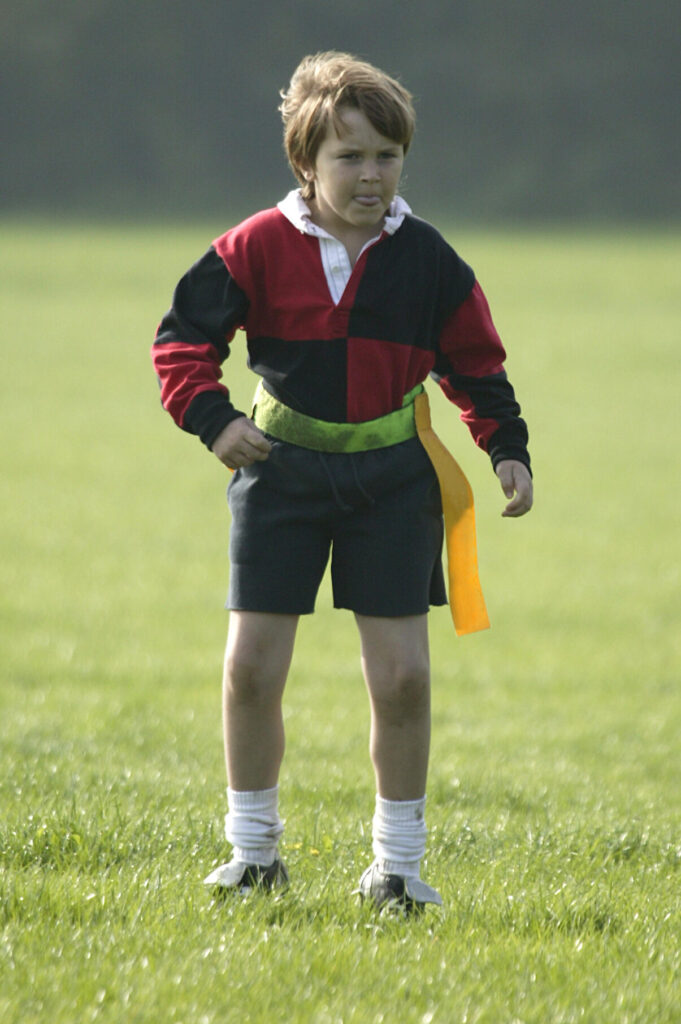
Tag Rugby is very similar to Touch Rugby and is very popular with younger children who can play this from as soon as they can run.
Each player wears a belt which has a number of cloth or plastic tags attached with velcro.
The rules of the game are to try and get the tags off the players of the opposing team. This teaches skills such as agility and speed without the players having to touch each other.
Walking Rugby:
A social form of rugby typically involves players over 55. As the name implies, walking rugby is slower-paced than other non-contact rugby variants.
Other forms of Rugby Union
As well as the 15 aside version of rugby union, there are a number of other options that may be available to your child.
Rugby Sevens:
In brief, Rugby Sevens is ordinary Rugby Union but played with teams of 7 players. It follows the same general laws of the game but with some modification.
The duration of the game is much shorter, halves are only 7 minutes long. This is important as Sevens is far more fatiguing than the 15 player game.
Sevens is played on a regular-sized pitch, so the players have to run a lot further as they have more space to cover between them.
Rugby Sevens is largely played at an amateur level and has featured in the Summer Olympics since 2016, contributing to the sport’s increasingly high profile.
Sevens players are generally lighter, faster and more agile which makes for fast-paced gameplay. For this reason it is a great sport for the casual viewer.
Rugby Tens:
Rugby Tens involves teams of 10 players for two 10-minute halves. Similar to Sevens, the reduced player count increases the game’s endurance aspects, justifying its shorter duration.
It offers a nice balance between the dynamism of Sevens and the physicality of the 15 player game.
Tens is less popular than Sevens but is still played in festivals at an amateur level. These can be great opportunities to compete with a greater focus on handling and running the ball.
Wheelchair Rugby:
Wheelchair Rugby is a sport for players with a range of disabilities. There are a few different disciplines of Wheelchair Rugby each with there own guidelines on what makes a player eligible but generally players must have impairments to their legs and arms.
This is the standard for the Paralympic Wheelchair Rugby discipline but other variations are accessible to people of any physical disability.
Wheelchair Rugby is unique in that it is played by mixed-gender teams despite being a contact sport. The level of contact however is not comparable to Rugby Union.
We must be clear and clarify that Wheelchair Rugby is its own sport operating under its own governing body, World Wheelchair Rugby.
World Rugby is not responsible for it’s competitions or regulations although the two organisations are partnered.
Great Britain Wheelchair Rugby governs the sport in the UK, check out their website for more details.

Blind Rugby/ Visually Impaired Rugby:
These are two sports formed for those who are either fully blind or visually impaired to different degrees. British Blind Sport organises these sports so once again they are not under the regulation of World Rugby but takes inspiration from the Rugby Sevens format.
Both versions utilise an audible rugby ball, designed to create noise for player tracking during passes and catches. The games have minimal contact and use a referee who, as well as officiating, commentates where the ball is to the players.
This video by British Blind Sport demonstrates what the game involved.
Deaf Rugby:
Deaf Rugby plays both sevens and fifteen-player formats. It follows Rugby Union rules but makes hearing-impaired adjustments.
Player unions for Deaf Rugby exist alongside the main governing bodies in countries where Rugby is popular although deaf players can play in either sport.
Teams can accommodate hearing-impaired players by following guidance from player unions for Deaf Rugby.
Before you go…
If some of the terminology in this article is new to you, why not head over to Key rugby terms everyone should know!


